
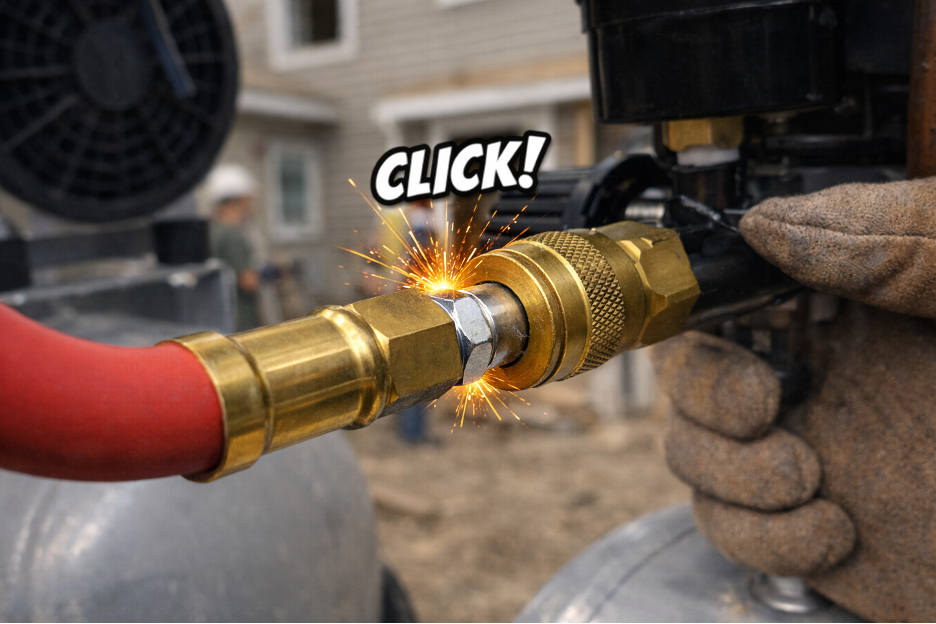
Boost Efficiency: The Benefits of Quick-Connect Couplings
Have you ever found yourself wrestling with threaded fittings while trying to swap out air tools, losing precious time and potentially causing leaks? In today’s fast-paced workshops and industrial settings, efficiency is paramount. Every second spent configuring equipment is a second not spent on productive work.
This is where quick-connect couplings come in, offering a simple yet incredibly effective way to streamline your pneumatic operations. At Master Tool Repair, we understand that reliable equipment is the backbone of your business. That’s why we’re dedicated to providing high-quality air compressor parts, including a wide selection of precision-engineered couplings.
What are Quick-Connect Couplings?
A quick-connect coupling (also known as a quick-disconnect fitting or air coupler) is a specialized connector used to join air lines rapidly. In a compressed air system, they allow you to connect and disconnect hoses to your compressor and various pneumatic tools with a simple "push-to-connect" motion. They consist of a male plug (the nipple) and a female socket (the coupler), which snap together securely and can be released instantly, often with one hand.
The Key Benefits of Quick-Connect Couplings
1. Significantly Enhanced Efficiency and Productivity
The primary advantage is the time saved. Traditional threaded fittings require wrenches, multiple turns, and the constant threat of cross-threading.
- Rapid Tool Changes: Swap from an impact wrench to a paint sprayer in seconds.
- Streamlined Setup: Quickly connect your compressor to the distribution system.
- Increased Versatility: Effortlessly adapt your setup to different tasks.
2. Reduced Downtime and Maintenance Costs
- Fewer Air Leaks: High-quality couplings feature integrated check valves that automatically close when disconnected, preventing air loss and reducing wear on your air compressor.
- Less Wear on Hoses: Frequent threading can damage hose ends. Quick-connect systems minimize this friction, extending equipment lifespan.
- Easier Repairs: If a coupling fails, it can be swapped out in seconds rather than minutes.
3. Improved Workplace Safety
- Prevents Hose Whip: The auto-shut-off feature prevents compressed air from escaping forcefully upon disconnection, protecting workers from the dangerous "whip" effect of uncontrolled hoses.
- Reduces Tripping Hazards: Easier hose management reduces clutter on the workshop floor.
Quick-Connect Interchange Comparison Guide
To maximize your system's efficiency, you must ensure your plugs and couplers match. Use this table to identify the most common air compressor coupling styles.
|
Interchange Style |
Common Name |
Visual Identifier |
Best For |
Typical Body Sizes |
|
Industrial |
Type M / Milton |
Two narrow stripes on the plug's "neck." |
Standard for most US workshops. |
1/4", 3/8", 1/2" |
|
Automotive |
Type T / Tru-Flate |
A shorter, thicker "nose" than Industrial. |
Professional automotive & tire centers. |
1/4", 3/8" |
|
ARO |
Type A / 210 Style |
A longer "nose" with a distinct thin groove. |
High-flow tools and assembly lines. |
1/4", 3/8" |
|
Universal |
Multi-Fit |
Female coupler with a "V" shaped interior. |
Accepting both Industrial and Automotive plugs. |
1/4" |
*** Eric’s Expert Tip: Don't Let Your Fittings Strangle Your Tools ***"One of the most common mistakes I see in the field isn't choosing the wrong style, but choosing the wrong flow size. Many guys will put a standard 1/4" body coupling on a high-demand tool like a 1/2" impact wrench or a large sander. Even if your compressor has the power, that small coupling acts like a kink in a garden hose, starving your tool of the air it needs to hit its full torque. If you’re running heavy-duty tools, look into 'High-Flow' or V-Style couplings. They maintain the same exterior thread size but have a larger internal bore. It’s the easiest way to get an immediate performance boost without buying a bigger compressor." |
If you’re running heavy-duty tools, look into 'High-Flow' or V-Style couplings. They maintain the same exterior thread size but have a larger internal bore. It’s the easiest way to get an immediate performance boost without buying a bigger compressor."
Frequently Asked Questions (FAQs) About Quick-Connect Couplings
Q: Are all air compressor quick-connect couplings the same? A: No. There are several distinct interchange patterns (Industrial, Automotive, ARO). They are not cross-compatible; an automotive plug will not lock securely into an industrial coupler.
Q: Why is my quick-connect coupler leaking air? A: Leaks are typically caused by a worn-out internal O-ring, a mismatched interchange style, or debris preventing the locking sleeve from seating fully.
Q: How do I know what size coupling I need? A: You must match two measurements: the body size (the flow capacity, usually 1/4" or 3/8") and the thread size (the part that screws into your hose). A 1/4" body is the standard for most DIY and automotive tools.
Why Master Tool Repair?
For over three decades, Master Tool Repair has been a leading provider of replacement parts for air compressors. We don't just sell parts; we provide the expertise to ensure you get the right component the first time. Whether you're a professional mechanic or a dedicated DIYer, we have the solutions to enhance your efficiency and safety.
Boost Your Efficiency Today
Don't let inefficient fittings slow you down. Browse our extensive selection of quick-connect couplings at Master Tool Repair and experience the difference first-hand.
Recent Posts
-
How to Prep Your Air Compressor for Peak Performance: The Spring Maintenance Checklist
When the seasons shift, your air compressor faces new challenges. Changes in temperature and humidit …Apr 7, 2026 -
Stop the Leaks: The Master Guide to Using Teflon Tape on Air Compressors
When you’re dealing with high-pressure systems, a single microscopic gap in a threaded connection ca …Apr 1, 2026 -
Breaker Tripping? Troubleshooting Air Compressor Overload Issues
It’s a universal frustration: You’re mid-project, the motor hums for a second, and then—click—the br …Mar 25, 2026