
Fix Low Pressure and Slow Fill: A Practical Troubleshooting Guide
Is your air compressor taking forever to reach "cut-out" pressure? Low pressure and slow fill times don't just waste your workday—they overheat your motor and significantly shorten the life of your pump.
The good news is that you can systematically find the cause with a few simple checks. Use this diagnostic flow to pinpoint failures, select the right replacement parts, and restore your performance with confidence.
Safety First
Before you touch a fitting or wire, ensure the unit is de-energized and unplugged. Bleed all air from the tank until the gauges read zero. Finally, verify the safety relief valve snaps open and reseats; if it sticks, replace it before further testing.
Step 1: Verify the "Brain" (Pressure Switch & Unloader Valve)
A weak or mis-set pressure control can often mimic pump problems. Start by confirming your supply voltage under load with a multimeter, as low voltage is a common cause of slow fill times.
Note your pressure switch cut-in and cut-out points. If the motor starts late or stops early, you may need to adjust or replace the switch. A key indicator of health is the unloader valve: you should hear a brief hiss when the motor stops. If there is no hiss, the motor will face high head pressure on the next start, causing hard starting and slow recovery.
Step 2: Test the Tank Check Valve
This is the "one-way door" between your pump and your tank. If it fails, air rushes backward from the tank into the pump head.
The Test: After the compressor stops, listen at the pump intake or the unloader line. A continuous, steady hiss indicates the check valve is not sealing. Replacing the check valve is usually faster and more reliable than trying to clean a worn internal spring or seal.
Step 3: Inspect Intake Filters and Reed Valves
Your pump needs to breathe freely. A clogged intake filter starves the pump and slashes your CFM (Cubic Feet per Minute) output. If the filter is dirty or oil-soaked, replace it.
If the filter is clean but you hear a rhythmic fluttering or feel air "puffing" back out of the intake while the motor is running, your reed (or disc) valves are the culprit. Failing pump valves cause extreme head temperatures and a stalled pressure climb. In these cases, a dedicated valve plate assembly or valve kit is required to restore the seal.
Step 4: Check the Transfer Tube and Fittings
The transfer tube carries air from the pump to the tank. Since this air is under high pressure, even a tiny pinhole is a significant loss.
Inspect the tube for rubbed spots, soot marks, or discoloration. The best way to find a leak here is to spray soapy water on the compression fittings at both ends. If you see bubbles, you have a leak. When replacing a tube, always duplicate the original length and diameter to maintain proper cooling.
Step 5: Evaluate Gauge and Regulator Accuracy
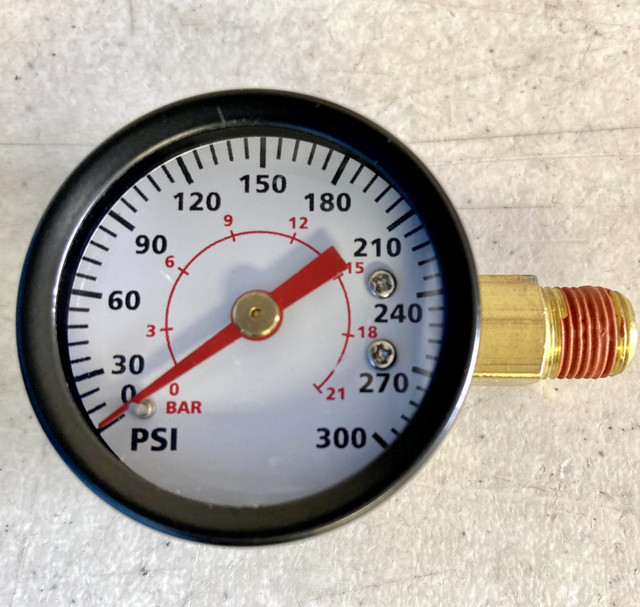
Sometimes the pump is fine, but the "ghosts" in your gauges are lying to you. Compare your tank gauge to a known good test gauge. If they are off by more than a few PSI, replace the gauge. Additionally, if your tools feel weak but the tank pressure is high, your regulator may be failing or restricted, starving the tools of the air they need.
Step 6: Assess Belt Tension and Pulley Alignment
On belt-driven units, mechanical slip equals lost air. Check your belt deflection; a loose or glazed belt will slip and squeal, while an over-tight belt will overload your motor bearings. Ensure the pulleys are perfectly aligned with a straightedge. Misalignment chews through belts and cuts the efficiency of the entire system.
Step 7: Confirm Pump Health Before a Rebuild
If you have sealed the air path and verified the controls, it’s time to look at the pump itself. Observe the "rise rate"—the time it takes to get from cut-in to cut-out—and compare it to the original specs.
On oil-lubricated units, check the oil condition. Milky oil suggests moisture ingress, while a metallic sheen suggests heavy internal wear. If the cylinder and crank are worn or the housing is damaged, a complete pump replacement is often more economical than a piecemeal rebuild.
Choosing the Right Parts: Your Identification Checklist
Finding the right part is the difference between a 20-minute fix and a week of frustration. Before you order, use this checklist to ensure a perfect match:
- Locate the Model and Serial Number: This is usually on a silver or white sticker on the tank or the motor shroud. This is the "Master Key" to finding your specific schematic. Also note the “Type” number on the label (if this applies). Some compressor models have multiple types!
- Identify the Pump Style: Is it an "Oil-Free" (often direct drive) or "Oil-Lube" (often belt-driven) pump? This determines which rebuild kits are applicable.
- Note the CFM and PSI Ratings: Check the data plate. Your replacement pressure switch or check valve must be rated to handle your compressor's specific output.
- Measure Port Sizes: If you are replacing a regulator or pressure switch, note the NPT (thread) sizes—common sizes are 1/4 inch, 3/8 inch, or 1/2 inch.
- Check the Voltage: Ensure your electrical components (motors, switches, magnetic starters) match your power supply—typically 120V or 240V.
- Document the Unloader Style: Does your pressure switch have a 1/4-inch compression fitting for the unloader line, or is it a quick-connect (or “push”-connect) fitting?
Need help identifying the right part? The experts at Master Tool Repair can guide you by model, CFM, and PSI. Reach out to CustomerService@MasterToolRepair.com or call 757-547-8665 for expert support.
Recent Posts
-
The Heart of Your Pump: Understanding Pump Intake & Exhaust Valves & Their Failures
At Master Tool Repair, we talk to customers every day who are frustrated by a compressor that just i …Mar 19, 2026 -

Boost Efficiency: The Benefits of Quick-Connect Couplings
Have you ever found yourself wrestling with threaded fittings while trying to swap out air tools, lo …Mar 11, 2026 -
How to Choose the Right Replacement Pump: Oil-Free vs Oil-Bath, CFM, and RPM
Replacing a tired air compressor pump is one of the fastest ways to restore airflow, tool performanc …Mar 3, 2026