
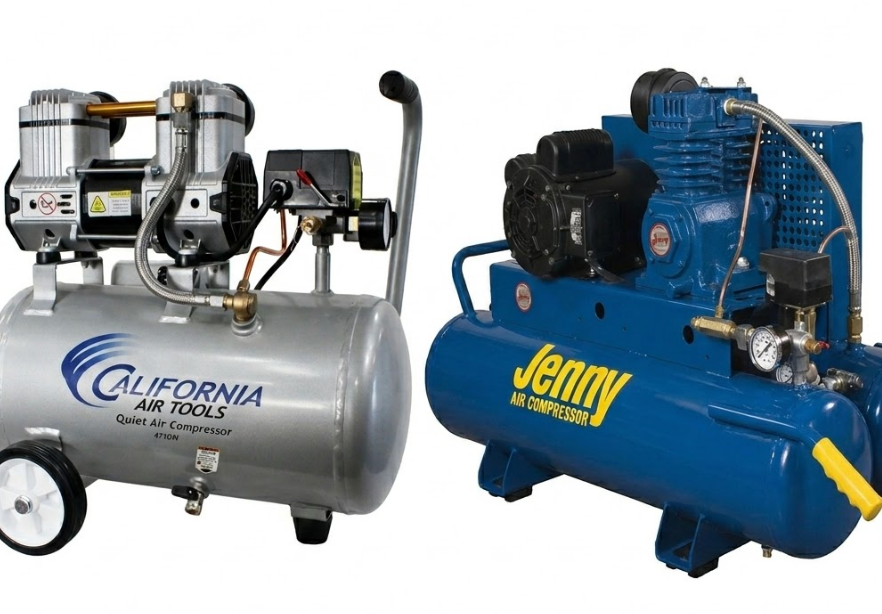
How to Choose the Right Replacement Pump: Oil-Free vs Oil-Bath, CFM, and RPM
Replacing a tired air compressor pump is one of the fastest ways to restore airflow, tool performance, and confidence in your setup. The challenge is getting the match right. A pump that overspeeds, starves for oil, or cannot meet your tools’ CFM needs will shorten lifespan and create downtime.
This blog walks you through the essentials, from oil-free vs oil-lubricated trade-offs to calculating required CFM at your working PSI, confirming pulley sizes and motor horsepower, and checking mounting and cooling details.
Start With Airflow: CFM at Your Working PSI
Airflow is the foundation. Look at the tools you run most and at the same time. Each tool lists a consumption rating, usually in cubic feet per minute (CFM) at a pressure, often 90 PSI. Add the concurrent tools and include a 25 percent buffer for pressure drop, hose length, and regulator losses. Then confirm the pump’s delivered CFM at your target PSI, not just its maximum.
- Nailers are light, often 2 to 4 SCFM at 90 PSI.
- Orbital sanders and grinders are heavy, often 8 to 12+ SCFM at 90 PSI.
- Paint spraying can require steady, high CFM at lower PSI.
Tool usage matters. Intermittent tools draw in bursts; continuous tools like DA sanders demand sustained flow. If you frequently run continuous tools, lean toward a higher CFM pump and a larger tank to reduce cycling and heat.
Duty Cycle, Cooling, and Expectations
Duty cycle describes how long a pump can run within a 10-minute window without overheating. Light-duty pumps might be comfortable at 50 percent duty cycle, while industrial units are designed for continuous duty with adequate cooling fins, flywheels, and aftercooling.
Match the pump to the workload:
- For intermittent work, a midrange duty cycle can be appropriate when paired with enough tank storage.
- For continuous sanding or shop use, choose a pump rated for heavy duty, ensure ample ventilation, and keep the flywheel shroud in place to move air across the cylinders.
Oil-Free vs Oil-Bath: How to Choose
Oil-free pumps use sealed bearings and non-metallic rings. They are convenient, lighter, and generally quieter at the smallest sizes, with no oil checks. Trade-offs include shorter ring life under heavy loads, higher operating temperatures, and more frequent replacement at high duty.
Oil-lubricated, oil-bath pumps circulate compressor oil over metal rings and bearings. They typically:
- Deliver longer service life under sustained loads.
- Run cooler, with better heat rejection.
- Require routine oil checks and seasonal oil changes.
Choose oil-free for clean, portable, light to moderate use where maintenance simplicity matters. Choose oil-bath for shop duty, continuous or near-continuous cycles, and the best longevity. If you select oil-bath, plan for correct oil viscosity, an oil sight glass you can read easily, and a spare filter to keep intake dust down.
Confirm Motor Horsepower, Voltage, and Starting Method
Pump capacity must align with what your motor can deliver. A true 3 HP electric motor on 230 V can support a smaller 2-cylinder single-stage pump; 5 HP typically pairs with larger 2-stage pumps or high-output single-stage units. If you upgrade to a larger pump without upgrading the motor and electrical, you risk hard starts, nuisance trips, and overheating. Compressors 5 HP and above typically benefit from a magnetic starter to protect the motor and pressure switch. If you are replacing both, consider a matched set.
Pulley Diameter, Flywheel, and RPM Matching
Every reciprocating pump has a recommended RPM (revolutions per minute) range. Exceed it, and you create excessive heat, vibration, and premature wear. Undershoot it, and you may not meet CFM targets.
Use this simple process:
- Find motor RPM on the nameplate. Common ratings are 3450 RPM or 1750 RPM.
- Measure the motor pulley outside diameter and the pump flywheel outside diameter.
- Estimate pump RPM using: Pump RPM = Motor RPM × (Motor Pulley Diameter ÷ Pump Flywheel Diameter).
- Compare that result to the pump’s recommended RPM range. Adjust pulley diameters to bring pump RPM into spec. Never increase motor pulley size without confirming the pump can handle the higher RPM.
- Keep belts properly tensioned and matched to the pulley type (A, B, or multi-groove). Replace cracked or glazed V-belts.
If you need a new flywheel or a different pulley to hit the correct speed, plan the swap at the same time you install the replacement pump. Proper airflow across the flywheel is also a cooling strategy, so keep guards in place.
Mounting Pattern, Port Sizes, and Plumbing Alignment
Before you buy, measure:
- Base bolt pattern and bolt size.
- Discharge port size and orientation.
- Transfer tube diameter and path to the check valve.
- Intake filter thread size and clearance under the shroud or cabinet.
A pump that fits the base but points the discharge toward a bracket can complicate the install. Verify room for the intake filter and ensure the head unloader or pilot valve line can be routed cleanly. If you are crossing brands, confirm the check valve size at the tank and plan an adapter if needed.
Accessories That Extend Pump Life
A new pump deserves protection and clean, dry air:
- Intake filtration: Replace or upgrade your intake filter regularly. Clean intake air reduces ring wear and valve plate carboning. You can browse air compressor filters to select the right size and media.
- Oil management: For oil-lubricated pumps, use the correct compressor oil, check the oil sight glass before every session, and change oil on a seasonal schedule for light duty or more often for heavy use.
- Air treatment: Install a line filter and water separator before your regulator. Clean, dry air protects tools and paint finishes, especially in cold weather.
- Safety relief valve: Size the valve approximately 30 PSI above your pressure switch cut-out so it protects against overpressure without nuisance venting.
- Drain routine: Open the tank drain daily. Moisture corrodes tanks and contaminates air lines. If your valve is sticky or leaks, replace the drain valve on your air compressor.
Replace or Rebuild: How to Decide
Rebuild makes sense when the crankcase, crank, and bores are sound. Symptoms like falling CFM, hard starting, and air at the intake often point to reed valves or gaskets. A valve plate and gasket kit can restore performance at a lower cost.
Replace the pump when you see scored cylinders, excessive endplay, cracked heads, or repeated overheating that blue-tints the flywheel and shroud. Also consider replacement when you need more CFM than the current frame can provide, or when parts availability is limited.
Helpful Resources & Next Steps
If you are ready to restore your air power, Master Tool Repair stocks OEM and compatible pumps for brands like Craftsman, Campbell Hausfeld, and Husky.
- Browse Pumps: https://mastertoolrepair.com/pumps-by-brand/
- Get Expert Advice: Contact CustomerService@MasterToolRepair.com or call 757-547-8665.
Choosing the right pump and supporting parts up front typically reduces install time and delivers years of reliable, efficient air.
Recent Posts
-
Master Your Air Flow: A Guide to Air Compressor Manifolds
In the world of pneumatic systems, efficiency is king. While many DIYers and professionals focus on …Apr 15, 2026 -
How to Prep Your Air Compressor for Peak Performance: The Spring Maintenance Checklist
When the seasons shift, your air compressor faces new challenges. Changes in temperature and humidit …Apr 7, 2026 -
Stop the Leaks: The Master Guide to Using Teflon Tape on Air Compressors
When you’re dealing with high-pressure systems, a single microscopic gap in a threaded connection ca …Apr 1, 2026