
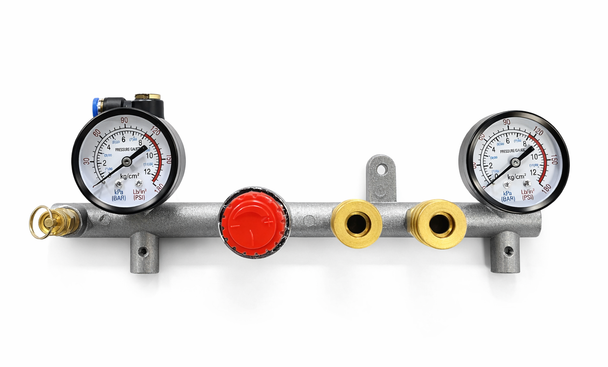
Master Your Air Flow: A Guide to Air Compressor Manifolds
In the world of pneumatic systems, efficiency is king. While many DIYers and professionals focus on the pump or the motor, there is one component that acts as the "nerve center" of your machine: the air compressor manifold.
If your compressor is the heart of your operation, the manifold is the primary artery. Understanding how it works, how to maintain it, and when to replace it is essential for keeping your project on track and your equipment safe.
WHAT IS AN AIR COMPRESSOR MANIFOLD?
An air compressor manifold is a distribution block—typically made of aluminum, brass, or cast iron—that directs compressed air from the tank to various outlets. It serves as the mounting point for several critical components, including:
- The Pressure Switch: The "brain" that tells the motor when to start and stop.
- The Pressure Gauge: Provides a visual readout of the air pressure inside the tank.
- The Regulator: Controls the amount of air pressure sent to your tools.
- The Safety Relief Valve: A critical fail-safe that prevents over-pressurization.
- Quick-Connect Couplers: Where you plug in your air hoses.
WHY THE MANIFOLD IS CRITICAL FOR PERFORMANCE
Without a functioning manifold, your compressor cannot regulate air or communicate with the motor. A cracked or leaking manifold leads to "short-cycling," where the motor turns on and off too frequently. This results in premature motor burnout and spiked energy costs.
SIGNS YOUR AIR COMPRESSOR MANIFOLD NEEDS REPLACEMENT
- Audible Air Leaks: A "hiss" near the gauges often indicates a hairline crack in the manifold body.
- Stripped Threads: Over-tightening fittings can strip internal threads, making a tight seal impossible.
- Visible Corrosion: Rust or oxidation around the ports compromises the structural integrity of the pressure vessel.
- Inaccurate Readings: Clogs or scale inside the manifold prevent the pressure switch from receiving accurate data.
ERIC'S EXPERT TIP
"When replacing a manifold, avoid using standard plumbing PTFE tape if possible. Instead, use a high-quality anaerobic thread sealant (like Loctite). Tape can shred during installation, and those tiny plastic fragments often find their way into the pressure switch diaphragm or the regulator, causing the very clogs you’re trying to prevent." - Eric Trotman, 20-Year Expert
HOW TO CHOOSE THE RIGHT REPLACEMENT MANIFOLD
When shopping for replacement parts at Master Tool Repair, accuracy is vital. You must match:
- Port Sizes: Most ports are 1/4 inch, 3/8 inch, or 1/2 inch NPT.
- Configuration: Count your ports (typically 3-port or 4-port setups).
- Material: Ensure the replacement material matches the original manufacturer’s specs for PSI ratings.
FREQUENTLY ASKED QUESTIONS (FAQ)
Q: Can I repair a cracked air compressor manifold with epoxy?
A: No. Because a manifold is a pressurized component, using epoxy or "cold weld" products is extremely dangerous and can lead to catastrophic failure. Always replace the part.
Q: Why does my manifold have more ports than I use?
A: Manufacturers often use one manifold for multiple models. If you have an extra port, you can safely seal it with a threaded internal hex plug.
Q: Is an air compressor manifold the same as a regulator?
A: No. The manifold is the stationary housing block. The regulator is a separate, adjustable component that screws into the manifold to control output pressure.
Recent Posts
-
Air Compressor Pumps 101: Understanding the Heart of Your Machine
If you rely on compressed air for your workshop, automotive garage, or industrial facility, you know …Jul 1, 2026 -
Common Mistakes to Avoid When Repairing Your Air Compressor
Fixing your own air compressor is an excellent way to save money, minimize project downtime, and ext …Jun 25, 2026 -
Ditch the Rust! Manual vs. Automatic Air Compressor Drain Valves
Every time you run your air compressor, physics works against your machine. As air compresses, it he …Jun 18, 2026