
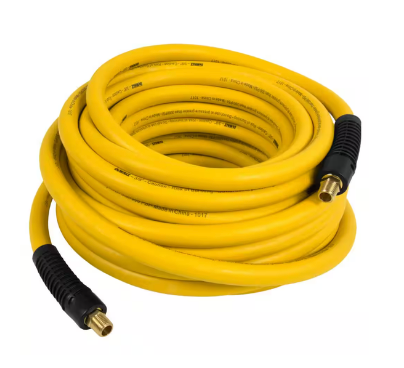
Pick the Perfect Hose: Navigating Air Compressor Air Hose Options
Choosing the right air hose is often the most overlooked step in setting up a pneumatic system. Many operators assume any hose will do, but the reality is that your hose acts as the lifeline between your compressor and your tools. Selecting the wrong material or diameter can lead to pressure drops, premature wear, and even safety hazards.
Understanding Hose Materials
The environment you work in dictates the material you need.
- PVC (Polyvinyl Chloride): Ideal for stationary work in climate-controlled shops. It is lightweight and economical but can become stiff and difficult to manage in cold weather.
- Polyurethane: Extremely lightweight - usually the lightest common hose type. PU is also very flexible, even in cold weather. It has low coil memory, which means it doesn’t tangle as badly as nylon, and recoils cleanly. However, it can kink more easily compared to rubber or hybrid hoses.
- Rubber: The traditional heavy-duty choice. Rubber hoses are abrasion-resistant and remain flexible in freezing temperatures, making them a favorite for construction sites.
- Hybrid (Polymer): These combine the best of both worlds. They offer the flexibility of rubber with the light weight of PVC and have no "memory," meaning they lay flat and don’t kink easily.
The Importance of Internal Diameter (ID)
Airflow is measured in CFM (Cubic Feet per Minute). If your hose diameter is too small, you create a "bottleneck" that starves your tool of power.
- 1/4-inch ID: Best for small trim nailers and light DIY tasks.
- 3/8-inch ID: The industry standard. It provides the best balance of weight and airflow for most air tools, including impact wrenches and spray guns.
Eric’s Expert Tip
"Most people blame their compressor when a tool loses power, but it’s often the hose. If you are running a hose longer than 50 feet, I always recommend stepping up to a 3/8-inch ID hose to minimize friction loss. A longer, thinner hose acts like a straw trying to move a milkshake—it just won't deliver the volume you need."
Length and Durability
While it’s tempting to buy a 100-foot hose "just in case," extra length increases pressure drop. Buy only as much hose as you need to reach your workspace comfortably. For high-friction environments like auto shops, ensure the hose has a high-quality outer cover to resist oil and chemical degradation.
Frequently Asked Questions (FAQs)
Q: What is the best air hose material for cold weather?
A: Rubber or Hybrid (Polymer) hoses are best for cold weather because they remain flexible at sub-zero temperatures, whereas PVC becomes brittle and difficult to coil.
Q: How do I know what size air hose I need?
A: Check your tool’s CFM requirements. For most general-purpose tools, a 3/8-inch internal diameter hose is the standard recommendation to ensure adequate airflow.
Q: Can I repair a leaking air hose?
A: Yes, you can use hose menders or crimp-on fittings to repair leaks. However, if the hose is showing signs of dry rot or multiple cracks, it is safer to replace the entire unit.
Q: Does hose length affect air pressure?
A: Yes. The longer the hose, the more pressure is lost due to friction against the inner walls of the hose. This is known as pressure drop.
Q: Should I disconnect my air hose from the compressor coupler if I’m not using it?
A: Yes. If the hose is pressurized. A pressurized hose stores energy; a failed fitting can whip dangerously. Starting under load is harder; dumping pressure prevents strain on the check valve and unloader. Hoses last longer when not held at high PSI continuously. Couplers and O‑rings wear faster when kept under pressure.
Recent Posts
-
Air Compressor Pumps 101: Understanding the Heart of Your Machine
If you rely on compressed air for your workshop, automotive garage, or industrial facility, you know …Jul 1, 2026 -
Common Mistakes to Avoid When Repairing Your Air Compressor
Fixing your own air compressor is an excellent way to save money, minimize project downtime, and ext …Jun 25, 2026 -
Ditch the Rust! Manual vs. Automatic Air Compressor Drain Valves
Every time you run your air compressor, physics works against your machine. As air compresses, it he …Jun 18, 2026