
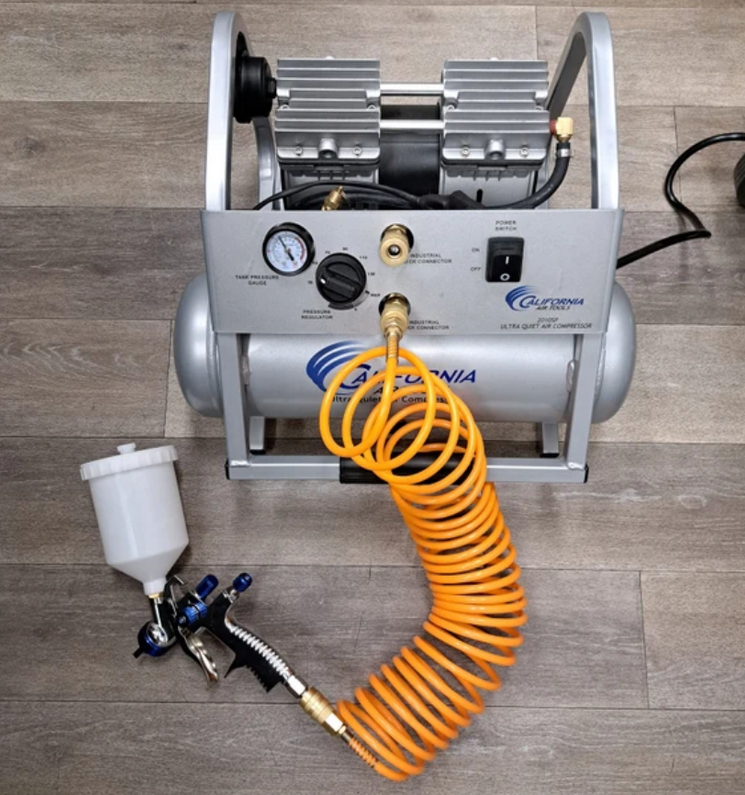
Setting Up Your Air Compressor for Painting: Beyond Just Pressure
Most DIYers and shop owners think a successful paint job is 90% technique and 10% pressure settings. In reality, the "invisible" factors inside your compressed air lines dictate whether you get a mirror finish or a fish-eye disaster. When you’re spraying lacquer, enamel, or automotive finishes, your air compressor isn't just a power source—it’s a delivery system for your medium.
To achieve professional results, you must look beyond the PSI gauge and focus on air quality and volume consistency.
1. The CFM vs. PSI Equation
While pressure (PSI) atomizes the paint, volume (CFM) sustains the fan pattern. Many painters make the mistake of using a small pancake compressor that meets the PSI requirement but falls short on CFM. This causes the pressure to drop mid-stroke, leading to uneven coverage. Always ensure your compressor’s "Delivered CFM" is at least 20% higher than your spray gun’s requirement to account for friction loss in the hoses.
2. Managing the Enemy: Moisture and Oil
Air compression naturally generates heat, which creates condensation. If water reaches your spray gun, it will cause bubbling and delamination.
- The Fix: Install a dedicated moisture trap and a regulator/filter combo at least 20 feet away from the compressor. This distance allows the air to cool enough for the water to condense so the trap can actually catch it.
- Oil Contamination: If you are using a lubricated reciprocating compressor, trace amounts of oil can bypass the piston rings. An oil coalescing filter and a point-of-use oil/water separator is non-negotiable for high-end finishes.
3. The Importance of Hose Diameter
A common bottleneck is the air hose itself. A standard 1/4" ID (Inner Diameter) hose often causes too much pressure drop over long distances. Switching to a 3/8" ID hose allows for better "buffer" volume, ensuring that when you pull the trigger, the initial burst doesn't starve the gun of air.
Eric’s Expert Tip:
"Most people drain their tanks once a week—that’s not enough for painting. Before you even mix your paint, perform a 'white cloth test.' Run air through your nozzle onto a clean white rag for 30 seconds. If you see even a hint of a yellow tint or a damp spot, your filtration isn't ready for a finish coat. If you’re using a desiccant dryer, check your separator's desiccant beads; if they’ve turned pink or clear, they’re saturated and useless. Consider upgrading your dryer and/or filter systems."
FAQ: Air Compressor Setup for Painting
How do I prevent "orange peel" texture in my paint? Orange peel is often caused by low air pressure or paint that is too thick. Ensure your regulator is maintaining a constant PSI and that your air filters are clear of debris that could cause a drop in flow.
Do I need a dryer if I already have a water trap? For automotive or fine furniture painting, yes. A water trap removes liquid water, but a desiccant dryer removes water vapor (humidity) that a standard trap might miss.
Can I use a tool oiler when painting? Absolutely not. If your airline has an inline oiler for pneumatic tools, you must use a completely separate hose and dedicated dry-line for painting to avoid catastrophic paint "fish-eyes."
What is the best way to maintain my compressor for painting? Regularly replace your air intake filters and check your manifold for leaks. At Master Tool Repair, we see many "pressure issues" that are actually just worn-out check valves or leaky gaskets.
Recent Posts
-
Air Compressor Pumps 101: Understanding the Heart of Your Machine
If you rely on compressed air for your workshop, automotive garage, or industrial facility, you know …Jul 1, 2026 -
Common Mistakes to Avoid When Repairing Your Air Compressor
Fixing your own air compressor is an excellent way to save money, minimize project downtime, and ext …Jun 25, 2026 -
Ditch the Rust! Manual vs. Automatic Air Compressor Drain Valves
Every time you run your air compressor, physics works against your machine. As air compresses, it he …Jun 18, 2026