
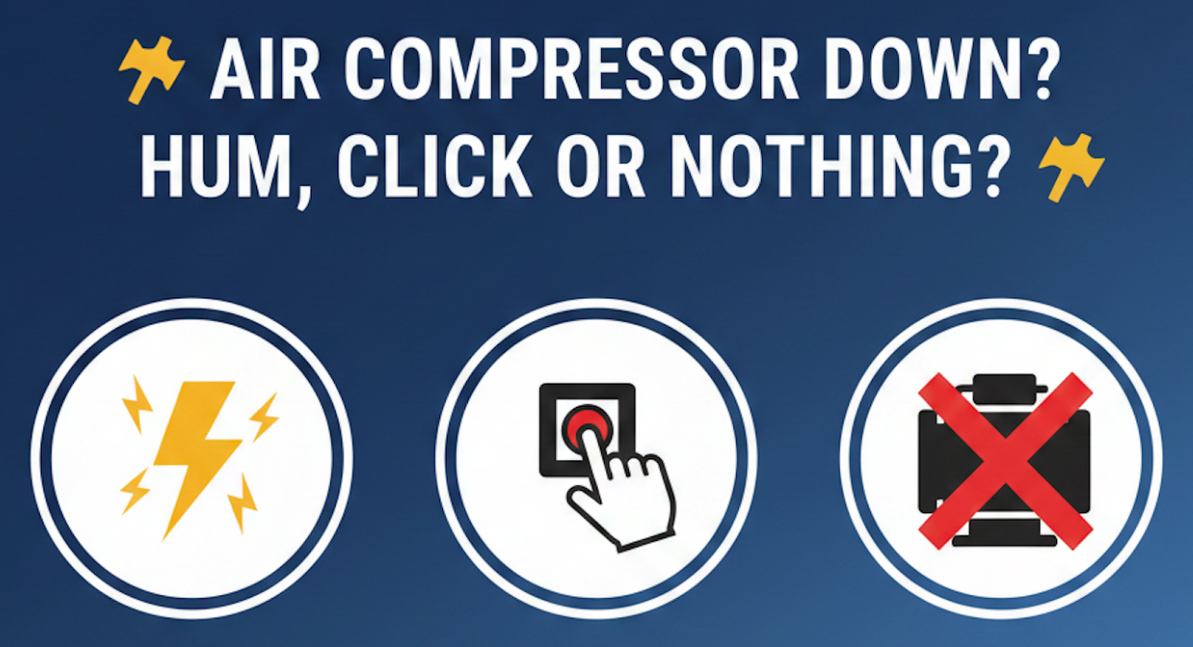
Troubleshooting Your Air Compressor When Your Motor Just Hums, Clicks, or Won't Start
There’s no sound more frustrating in a workshop than the failed attempt of an air compressor to start. Instead of the satisfying roar of a motor kicking on, you get a hesitant hum, a lonely click, or, worst of all, silence.
When this happens, your project stops, but the solution is often simpler (and cheaper) than buying a new unit. At Master Tool Repair, we know these symptoms are clues. Here is your definitive guide to diagnosing the three most common air compressor motor issues and getting the right replacement part to fix it.
The "Hum": When Your Motor Struggles to Spin
A motor that hums but won't turn is receiving power but can't generate the necessary rotational force (torque) to overcome resistance. This almost always points to an electrical failure or an impossible mechanical load.
1. Failed Start or Run Capacitors
The capacitor is the single most common culprit for a "hum." It’s a small, battery-like device that gives the motor the huge surge of power (the "jolt") it needs to start spinning.
- The Problem: If the capacitor fails, the motor draws current but can't start the rotation, resulting in a persistent, straining hum. Visually check for capacitors that look swollen, bulging, or are leaking fluid.
- The Fix: Replace the faulty capacitor immediately. Warning: Capacitors hold an electrical charge even when the unit is unplugged. Always discharge them safely before handling or replacing. Find out how to do this here.
2. Stuck Check Valve (The Pressure Problem)
The second major cause of humming is a mechanical load that is too great to overcome. When your compressor shuts off, the check valve is supposed to seal the tank and prevent compressed air from flowing back to the pump head.
- The Problem: If the check valve is stuck open, tank pressure flows backward, leaving the motor to try and start against a head full of high-pressure air. This puts an overwhelming load on the motor, causing it to hum and quickly trip the thermal overload.
- The Fix: Test your check valve. If it’s faulty, replace it. This is a crucial, inexpensive repair that saves your motor from catastrophic failure. Find out how to inspect and test the check valve here.
3. Thermal Overload Protection
The compressor motor may hum for a moment, then shut off completely.
- The Problem: The motor's internal thermal overload switch may have tripped to prevent the motor from burning out, usually due to the strain of a stuck check valve or a capacitor failing to help it start.
- The Fix: Let the motor cool down completely and press the manual reset button (if equipped). If it immediately trips again, a component (like a capacitor or check valve) is causing excessive load or heat, and needs replacement.
The "Click": What the Pressure Switch is Telling You
If you hear a clear, distinct click when you try to start the compressor, it means the pressure switch is attempting to send power to the motor, but the power isn't making it, or the motor is rejecting it.
1. Corroded Pressure Switch Contacts
The pressure switch is the brain of your compressor, telling the motor when to turn on (cut-in pressure) and off (cut-out pressure).
- The Problem: Over time, the contacts inside the switch become pitted, corroded, or welded shut. The switch attempts to click and complete the circuit, but the poor connection prevents enough electricity from reaching the motor.
- The Fix: Inspect the pressure switch and its wiring connections. If the contacts are visibly damaged or corroded, the entire switch usually needs to be replaced. Find out how to do this here and here.
2. Unloader Valve Failure
The pressure switch assembly often includes an unloader valve (or a solenoid valve) that releases the small amount of air pressure trapped in the line between the pump and the check valve after the unit shuts down.
- The Problem: If the unloader valve fails to vent this pressure, the motor encounters the same impossible starting load as a faulty check valve—leading to a strained start and a quick shutdown (often with a click).
- The Fix: When the compressor shuts off, listen for a quick, audible hiss of air escaping. If you don't hear it, the unloader valve may be stuck and needs to be replaced, often by installing a new pressure switch assembly. Find more info on the unloader valve here.
The "No Start": Silence is Not Golden
If you flip the switch and hear absolutely nothing—no hum, no click, just silence—the issue is typically power supply or a total component failure.
1. Check the Basics
Start simple: Is the power cord plugged directly into a properly rated outlet (avoid extension cords)? Is the circuit breaker or fuse on your electrical panel tripped? Is the compressor's thermal overload reset button depressed?
2. Complete Pressure Switch or Motor Failure
If the power supply is confirmed, the silence means the pressure switch is not sending the "start" signal, or the motor is completely dead.
- The Fix: If the pressure switch is silent and the tank is below cut-in pressure, replace the Pressure Switch. If the pressure switch is confirmed to be sending power, the only remaining major component is the Electric Motor itself.
Whether you need a replacement start capacitor, a critical check valve, or an entire electric motor assembly, Master Tool Repair stocks thousands of OEM and compatible parts for every major brand—from Craftsman and DeWalt to Porter Cable and Campbell Hausfeld.
Recent Posts
-
How to Prep Your Air Compressor for Peak Performance: The Spring Maintenance Checklist
When the seasons shift, your air compressor faces new challenges. Changes in temperature and humidit …Apr 7, 2026 -

Stop the Leaks: The Master Guide to Using Teflon Tape on Air Compressors
When you’re dealing with high-pressure systems, a single microscopic gap in a threaded connection ca …Apr 1, 2026 -
Breaker Tripping? Troubleshooting Air Compressor Overload Issues
It’s a universal frustration: You’re mid-project, the motor hums for a second, and then—click—the br …Mar 25, 2026