
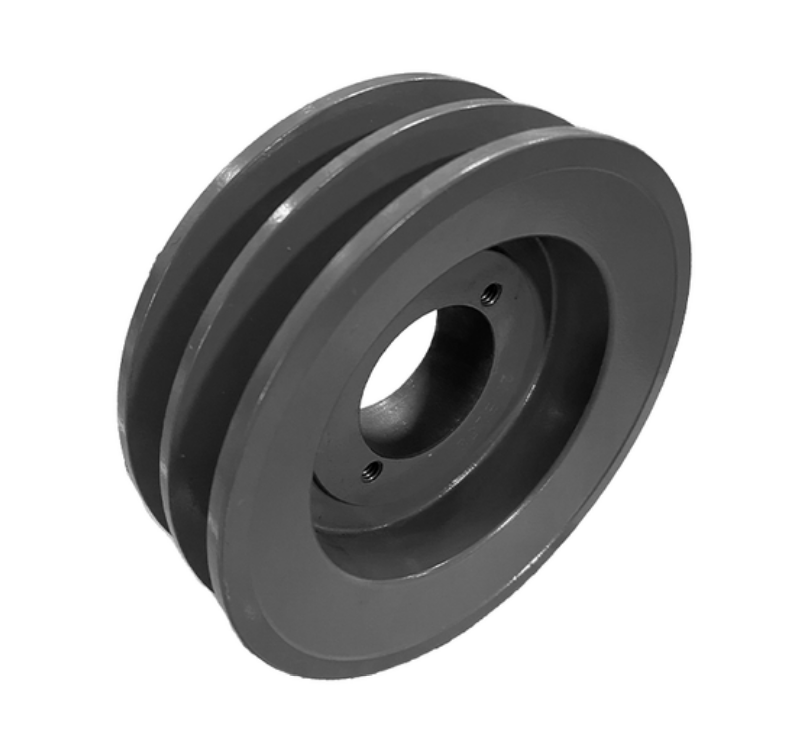
How to Size, Align, and Replace Your Air Compressor Pulley
An air compressor pulley might look like a simple piece of metal, but it plays a critical role in your system’s performance. The pulley regulates the operating speed of your pump, controls airflow, and ensures the motor doesn't overload. If your air compressor is vibrating excessively, destroying belts, or failing to build pressure, the culprit is often an improperly sized, misaligned, or worn-out pulley.
Understanding how to properly size, align, and replace your air compressor pulley will extend the lifespan of your machine and prevent costly motor burnouts.
How to Calculate Air Compressor Pulley Sizing
To maintain the correct Revolutions Per Minute (RPM) for your compressor pump, the motor pulley and the pump flywheel must be precisely proportioned. Incorrect pulley sizing can cause the pump to run too fast (leading to overheating and catastrophic failure) or too slow (resulting in poor CFM output).
The mathematical formula to determine air compressor pulley sizing is:
Motor Pulley Diameter×Motor RPM=Pump Flywheel Diameter×Pump RPM
To find a missing variable, use these standard calculations:
- To find the required motor pulley size: Multiply the pump flywheel diameter by the desired pump RPM, then divide by the motor RPM.
- To find the pump RPM: Multiply the motor pulley diameter by the motor RPM, then divide by the pump flywheel diameter.
- If you want a shortcut to calculate the required motor pulley size, or to calculate any other variable, you can use a handy online calculator.
When measuring an existing pulley, always measure the Outside Diameter (OD) and the pitch diameter (where the belt actually rides in the groove) to ensure a precise match when purchasing replacement parts.
Step-by-Step Air Compressor Pulley Alignment
Pulley misalignment is the leading cause of premature belt wear, loud operational noise, and unnecessary strain on the crankcase bearings. The two pulleys must sit perfectly parallel on the same plane.
- Disconnect Power: Always lock out the power source before performing maintenance.
- Inspect for Angular and Parallel Misalignment: Place a straightedge (like a carpenter's level or a straight piece of metal) firmly against the outer face of the pump flywheel. Extend it across to meet the motor pulley.
- Identify Gaps: The straightedge should touch all four points of the two pulleys simultaneously (two points on the flywheel, two points on the pulley). If there is a gap on one side of the motor pulley, it is misaligned.
- Adjust the Pulley Position: Loosen the set screw or the taper-lock bushing on the motor pulley. Slide the pulley along the motor shaft until it perfectly aligns with the straightedge.
- Secure and Re-test: Tighten the set screw securely onto the flat spot of the shaft, rotate the belt by hand to check tracking, and restore power.
Eric’s Expert Tip
"When aligning or replacing your compressor pulley, never rely on visual estimation alone. A fraction of an inch of misalignment generates friction that can melt a standard V-belt in a matter of hours. I always use a precision straightedge across the machined faces of both the flywheel and the pulley. Additionally, whenever you replace a pulley, always inspect your belt for uneven wear. If the pulley was tracking incorrectly, the belt is likely compromised and should be replaced at the same time to prevent a breakdown under heavy load."
How to Replace a Worn Air Compressor Pulley
If your pulley grooves are grooved, pitted, or cracked, or if the pulley wobbles on the shaft, it must be replaced immediately.
- Remove the Belt: Loosen the motor mounting bolts to slide the motor forward, releasing tension on the belt, and slide the belt off.
- Loosen the Fasteners: Back out the set screw using an Allen wrench. If your compressor uses a taper-lock bushing, remove the mounting bolts and insert them into the threaded push-out holes to break the pulley loose from the bushing.
- Use a Pulley Puller: Never strike the pulley with a hammer, as cast-iron and aluminum pulleys fracture easily. Attach a jaw-style pulley puller to safely slide the old pulley off the motor shaft.
- Clean the Shaft: Use emery cloth to remove rust, burrs, or debris from the motor shaft. Ensure the keyway key is intact and fits snugly.
- Install the New Pulley: Slide the new pulley onto the shaft, align it using the straightedge method detailed above, apply a thread-locking compound to the set screw, and torque it down tightly. Re-tension the belt so there is roughly 1/2 inch of deflection when you press down at the centerpoint between the motor and the pump.
FAQs
Q: What happens if I put a larger pulley on my air compressor motor?
A: Putting a larger pulley on your air compressor motor increases the RPM of the compressor pump. While this may temporarily increase your CFM (Cubic Feet per Minute) output, it will overload the motor, draw excessive amperage, overheat the pump, and likely trip your breaker or burn out the motor.
Q: How tightly should an air compressor pulley set screw be tightened?
A: An air compressor pulley set screw must be tightened firmly against the flat portion of the motor shaft, typically torqued to 110–150 inch-pounds for standard fractional horsepower motors. Always use a medium-strength thread locker (Blue Loctite) to prevent the screw from backing out due to natural machine vibration.
Q: Why does my air compressor pulley keep eating belts?
A: Your air compressor pulley is likely eating belts due to pulley misalignment, a worn pulley groove that has become sharp or uneven, or incorrect belt tension. If the pulleys are not aligned on the same plane, the belt will ride on the edge of the groove, creating excessive friction, heat, and rapid shredding.
Q: Should I choose an aluminum or cast-iron replacement pulley?
A: Cast iron pulleys are highly recommended for industrial, high-duty-cycle air compressors because they offer superior durability, resist groove wear, and handle high heat better. Aluminum pulleys are acceptable for smaller, light-duty, or DIY portable compressors where weight reduction is prioritized over long-term industrial wear resistance.
Recent Posts
-
Air Compressor Pumps 101: Understanding the Heart of Your Machine
If you rely on compressed air for your workshop, automotive garage, or industrial facility, you know …Jul 1, 2026 -
Common Mistakes to Avoid When Repairing Your Air Compressor
Fixing your own air compressor is an excellent way to save money, minimize project downtime, and ext …Jun 25, 2026 -
Ditch the Rust! Manual vs. Automatic Air Compressor Drain Valves
Every time you run your air compressor, physics works against your machine. As air compresses, it he …Jun 18, 2026