
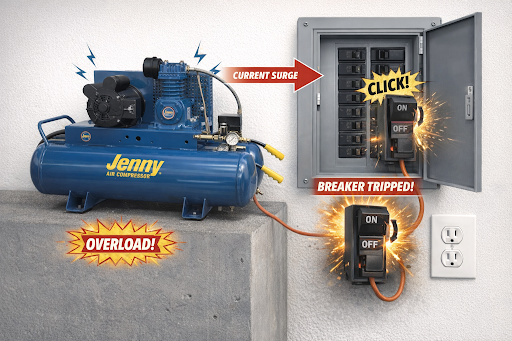
Breaker Tripping? Troubleshooting Air Compressor Overload Issues
It’s a universal frustration: You’re mid-project, the motor hums for a second, and then—click—the breaker trips. At Master Tool Repair, we know that a tripping breaker isn't just a nuisance; it’s your system’s way of screaming for help before a motor burnout occurs.
Why Your Air Compressor is Tripping the Breaker
When an air compressor draws more current (amperage) than the circuit is rated for, the breaker trips to prevent a fire. Here are the most common culprits our experts see in the field:
1. Faulty Unloader Valve
If the unloader valve fails to release trapped air over the piston after a cycle, the motor must start against high pressure. This "hard start" causes a massive spike in amperage.
2. Defective Start Capacitor
The capacitor gives the motor the "kick" it needs to get spinning. If it’s weak or blown, the motor will struggle to start, draw excessive power, and trip the breaker almost instantly.
3. Extension Cord Issues
This is the most common DIY mistake. Using an extension cord that is too long or too thin (low gauge) causes a voltage drop. To compensate for low voltage, the motor draws more amps, leading to heat and a tripped breaker.
4. Failing Check Valve
If the check valve is leaking, tank pressure pushes back against the pump. Similar to a bad unloader valve, this forces the motor to work harder than it was designed to during startup.
5. Poor Lubrication or Internal Friction
If the pump oil is low or contaminated, internal friction increases. The motor has to work overtime to turn the pump, leading to an "overload" state.
Eric’s Expert Tip
"Before you go replacing the motor, check your check valve! A simple way to test it: drain your tank completely and try to start the unit. If it starts fine empty but trips the breaker when there’s pressure in the tank, your check valve or unloader valve is likely the culprit, not the motor itself. Another full-proof test is to run the unit to max pressure (if possible) and allow it to shut off. If you hear a constant air leak coming from the unloader valve on the pressure switch, the check valve is the culprit." - Eric Trotman, 20-Year Technical Expert
FAQ: Common Compressor Overload Questions
Q: Can I just use a bigger breaker?
A: No. Never increase the breaker size without upgrading the wiring. This is a major fire hazard. The breaker is sized to protect the wires in your wall.
Q: How do I know if my start capacitor is bad?
A: Look for physical signs like bulging, leaking fluid, or a burnt smell. You can also test it with a multimeter set to capacitance.
Q: What extension cord should I use?
A: Ideally, none. If you must, use a heavy-duty 12-gauge cord and keep it under 25 feet.
Recent Posts
-
Ditch the Rust! Manual vs. Automatic Air Compressor Drain Valves
Every time you run your air compressor, physics works against your machine. As air compresses, it he …Jun 18, 2026 -
How to Size, Align, and Replace Your Air Compressor Pulley
An air compressor pulley might look like a simple piece of metal, but it plays a critical role in yo …Jun 10, 2026 -
Essential Air Compressor Gasket & O-Ring Kits: The Foundation of a Leak-Free System
Air compressors are the workhorses of any shop, but their power depends entirely on the integrity of …Jun 3, 2026